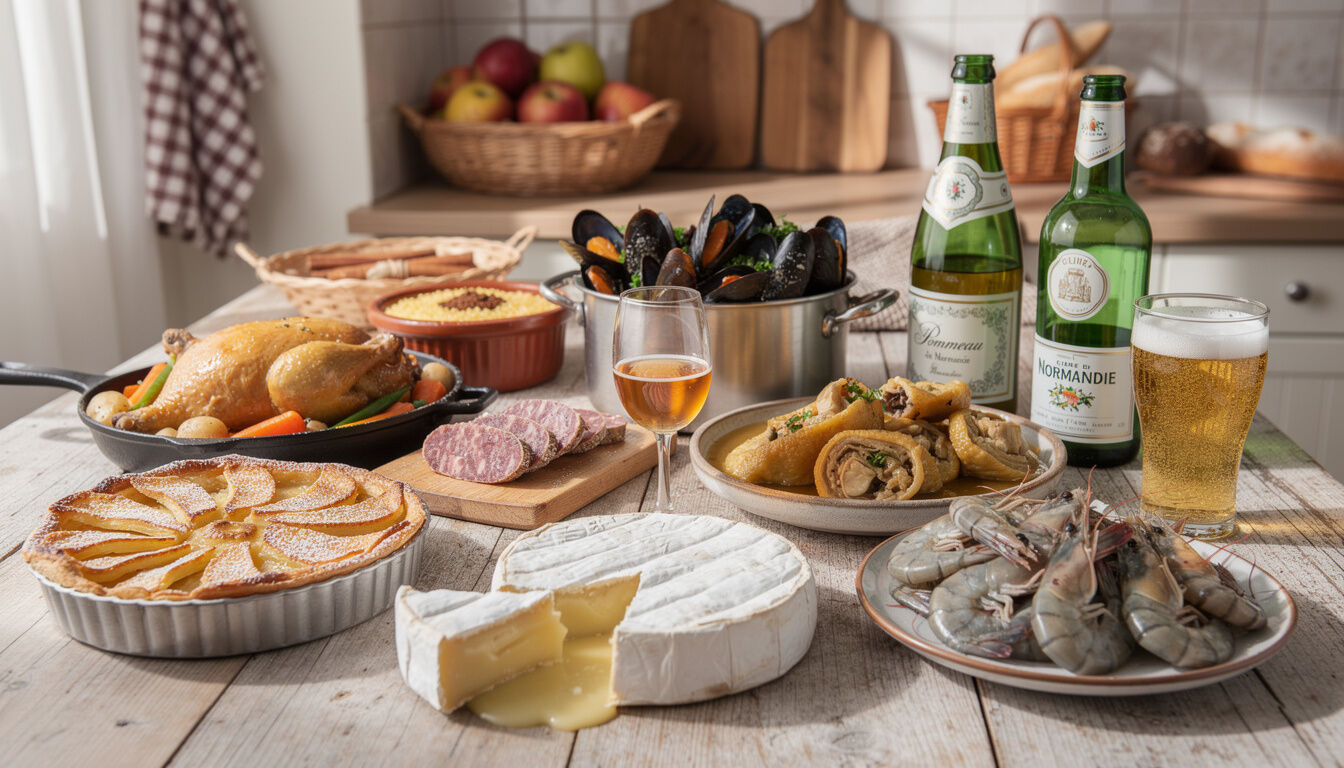
It only takes a Saturday morning market in Caen to understand what makes Normandy so unique at the table: the salt air on the stalls, the scent of melting butter, and that persistent presence of apples that links orchards to plates. Here, the landscapes are not a backdrop; they dictate the recipes. Between bocage and cliffs, lush meadows and lively ports, every corner of Normandy speaks a language of terroir, carried by a patient savoir-faire and a demanding idea of “good.”
People often think they know the region through two or three symbols. Yet Norman gastronomy depends as much on gestures as on products: a cream that coats without heaviness, a cider served at the right moment, a long cooking time that transforms a humble dish into a celebratory moment. From family tables in the Bessin to inns near the Mont-Saint-Michel, the same landmarks recur: generosity, precision, and that authenticity that is not folklore. The journey begins with the geography; it ends in memory, when the flavors linger long after the last bite.
In short the landmarks for savoring Normandy without making mistakes
Contrasting landscapes that shape a rich terroir: sea, valleys, bocage, marshes.
The great cheeses: Camembert de Normandie, Livarot, Pont-l’Évêque and Neufchâtel, to taste and to cook with.
The dairy trio of Isigny: milk, butter and cream as the backbone of sauces and desserts.
Apples everywhere: fruit, desserts, and drinks (cider, pommeau, calvados).
Very fresh seafood: oysters, mussels from Barfleur, scallops from the Seine Bay.
Iconic dishes: tripes à la mode de Caen, poulet Vallée d’Auge, roasted camembert, andouille de Vire.
Rituals and conviviality: the trou normand, markets, festivals, brotherhoods, gourmet routes.
Les terroirs variés de la gastronomie normande
Normandy is never a single flavor. It is an assemblage of climates and soils that explain, almost mechanically, the diversity of products.
On the coast, the salty air and the tides structure the cuisine of the ports; in the bocage, lush grass feeds renowned dairy cows; further south, the Perche asserts a peasant tradition where long time is respected. This mosaic of terroir is read on the plates, from cream sauces to slow-cooked dishes.
To prepare a gourmet stay, some practical markers are worth their weight in gold. the resources of gastronomy in Normandy give a clear idea of areas, seasons and experiences, from the local market to the farm-inn.
An illustrative example: in the same week, a fictional family — the Lecomtes, living near Caen — can buy oysters for an aperitif, a butter from Isigny for Sunday baking, and a farm cider to accompany a poultry dish. Coherence does not come from a single recipe, but from a thread: the right product at the right time. Final insight: in Normandy, the landscape is an open-air cookbook.
Les fromages emblématiques de Normandie : Camembert, Pont-l’Évêque, Livarot et Neufchâtel
In Normandy, cheese is not just an end-of-meal board: it is a language. It tells of the meadows, the dairy savoir-faire, and the ability to turn an everyday product into a cultural symbol.
Camembert de Normandie embodies the soft paste with a bloomy rind, with a texture that goes from firm to runny depending on aging. Pont-l’Évêque, more square and creamier, offers a softness that appeals to both novices and aficionados. The Livarot, recognizable by its bands, assumes a more pronounced character, while Neufchâtel, often heart-shaped, plays the card of milky finesse.
To explore other tasting routes and dishes, the selections of Norman products to savor help pair cheeses, drinks and table ideas. Final insight: these cheeses are different, but they share one thing — precision of the gesture.
Caractéristiques et modes de consommation des fromages normands
The first secret is simple: the right temperature. Taking a Livarot or a Neufchâtel out of the fridge too late is to restrain the aromas and flatten the flavors.
When buying, look at the rind: it must be alive, not dried out. A well-aged Camembert has a supple paste in the center; a Pont-l’Évêque succeeds when it remains soft without “running.”
Two ways of serving them work very well in Normandy: natural with a slightly toasted loaf, or paired with slices of tart apples. And for drinks, a dry cider sharpens the salt and fat, while a rounder cider caresses creamy pastes. Final insight: Norman tasting plays on the balance between milky sweetness and fruity freshness.
Intégration des fromages dans les recettes traditionnelles normandes
The cheeses of Normandy become ingredients, not just stars. In a sauce, a dash of cream acts as a bridge: it softens the power and binds textures.
For a quick dinner, roasted camembert (in the oven, with a clove of garlic and a splash of cider) turns a board into a main dish. In a quiche with Pont-l’Évêque, the crust should remain thin to let the cheese speak.
Families around Caen also like to slip a leftover Neufchâtel into mashed potatoes: the result is silkier than with butter alone. For other inspirations, these typical dishes to discover show how cheese naturally integrates into regional preparations. Final insight: cooking with cheese multiplies its nuances without betraying it.
L’importance du lait, beurre et crème d’Isigny dans la cuisine normande
Impossible to talk about Normandy without evoking the milk-butter-cream triad, especially when it comes from Isigny. These products are not a luxury: they structure sauces, gratins, and even the way meat is seared.
Isigny butter stands out for a supple texture and an ability to foam without burning too quickly. In everyday cooking, this changes everything: a knob in a pan, and the flavors become clearer, more “long.”
Isigny cream plays on creaminess. In a velouté, it brings volume without heaviness; in a calvados sauce, it stabilizes the alcohol and reveals the note of apples. Artisans here speak of savoir-faire: quality is not only in taste, but in the product’s behavior during cooking. Final insight: in Normandy, fat is not excess, it is a mastered culinary tool.
La pomme en Normandie : fruit vedette de la gastronomie locale
Apples are as much a landscape as an ingredient. They are found along roads lined with orchards, in desserts, and even in some savory sauces.
The heart of the matter is variety: depending on whether it is sweet, tart, bitter or aromatic, the same apple will not give the same result. In Normandy, this cultivation is accompanied by respect for the calendar, because an apple ripe at the right moment changes the texture of a compote, the hold of a tart, and even the profile of a cider.
If you like to plan a gourmet itinerary, these Norman culinary treasures show how the fruit fits into local habits, from snack to digestif. Final insight: the Norman apple is a red thread, never mere decoration.
Variétés de pommes cultivées en Normandie
Norman orchards cultivate complementary profiles: sweet apples for balance, tart ones for tension, and bitter ones for aromatic structure. This trio serves both the table and the drinks.
In the Pays d’Auge or toward the Manche (50) not far from the Mont-Saint-Michel, producers often compose blends. The goal is not the “perfect” apple, but the coherent mix that will give relief, notably for cider and calvados.
Sweet: bring roundness and sweetness in cooking.
Tart: wake up dishes, ideal in butter-pan-fried slices.
Bitter: useful in blends to complexify a characterful cider.
Final insight: in Normandy, the taste of an apple is thought of as a palette, not a single note.
Desserts traditionnels à base de pommes : tarte, teurgoule et autres
The Norman apple tart is not an ordinary tart: it embraces richness thanks to a cream-based filling and sometimes a touch of calvados. Baking must be decisive to caramelize the edges without drying the center.
Teurgoule, that rice pudding cooked for a long time, belongs to recipes that teach patience. Many families around Caen put it in the oven early in the morning: the brown crust forms slowly, and the inside remains creamy, especially when the milk is rich. Served with roasted apples, it becomes a dessert of memory.
For a more modern wink, some chefs in Bayeux offer an apple candied in Isigny butter, placed on a shortbread. Final insight: Norman desserts rely on the simplicity of gestures, not complexity.
Les boissons normandes issues de la pomme : cidre, pommeau et calvados
Normandy turns apples into drinks that accompany a meal from start to finish. Where other regions think “wine,” here one often thinks cider for the aperitif, then a glass of calvados at the right moment.
The key point is intention: cider is drunk with the table, pommeau plays the sweet-salty match, and calvados brings the depth of a spirit. For a general overview, the culinary specialties to taste place these drinks in a complete experience. Final insight: in Normandy, the apple is drunk as much as it is eaten.
Méthodes d’élaboration du cidre doux et brut
Cider always begins with a careful harvest: apples sorted, washed, then crushed. The juice then ferments, and it is the management of that fermentation that distinguishes a sweet cider from a dry one.
A sweet cider retains more sugars, thus a rounder sensation. A dry cider goes further in fermentation: it becomes drier, livelier, excellent with creamy dishes or fish.
Type | Profile | Recommended pairings in Normandy |
|---|---|---|
cider sweet | Round, fruity, slightly sweet | Apple desserts, crêpes, snack time |
cider dry | Dry, more structured, clean finish | Cheeses, galettes, cream-based dishes |
Final insight: the right cider does not imitate wine, it proposes a different rhythm at the table.
Différences et accords gastronomiques du pommeau et du calvados
Pommeau is an aperitif where apple must is fortified with Calvados, creating a sweet, warm drink, ideal with a blue cheese or foie gras. It bridges fruit and alcohol without aggressiveness.
Calvados, meanwhile, is a brandy resulting from distillation and then aging. Young, it can be lively and very fruity; older, it gains notes of wood, spices, and remarkable length.
At the table, a splash of calvados (in a sauce, or flambéed) changes the perception of fat: with cream, it becomes velvet. And as a digestif, it pairs perfectly with a dessert of caramelized apples. Final insight: pommeau and calvados do not replace each other; they correspond to different moments of the meal.
Les fruits de mer normands : fraîcheur et recettes authentiques
The Normandy coastline imposes an obvious rule: when the sea is close, freshness becomes a rule, not a marketing argument. On the quays, a good product is recognized by its smell — never too strong — and the liveliness of its textures.
Seafood is often appreciated simply, but regional cuisine also likes to accompany it with a light cream, herbs, or a touch of dry cider. To extend these discoveries, the region’s culinary treasures give ideas for stops and producers. Final insight: here, the sea is enjoyed without artifice, but never without demand.
Moules de Barfleur et coquilles Saint-Jacques de la baie de Seine
In Barfleur, mussels are a local pride: small, tight, and very flavorful. A classic preparation is to open them with cider, then bind them with a supple cream and a little shallot. The result has that sweetness that respects the brininess.
The scallops from the Seine Bay are another emblem. Quickly seared in Isigny butter, they keep a nacreous center, then pair with a short sauce of dry cider. This quick cooking is a demonstration of savoir-faire: one minute too many and everything tightens.
When the Lecomtes host friends in Caen, they often serve scallops as a starter with pan-fried apple wedges: the acidity wakes the sea. Final insight: in Normandy, the precision of cooking gives the product all its nobility.
Huîtres des côtes normandes et modes de préparation traditionnels
Norman oysters are first enjoyed raw, because the salinity and texture tell the place. A simple squeeze of lemon is enough, even if some prefer a splash of dry cider to underline the minerality.
In a hot version, a tradition is to gratin the oysters with a touch of cream and a fine breadcrumb: it’s indulgent, but it requires a light hand. Too much cooking, and the briny note disappears.
On the road to the Mont-Saint-Michel, small stalls sometimes offer a mixed plate of seafood, where one immediately understands the difference between real freshness and a transported product. Final insight: a successful oyster is the sea held in a shell, without detour.
Plats traditionnels normands et leurs secrets culinaires
Norman dishes have one thing in common: they do not cheat with time. Many recipes were born from farmhouse and inn cooking, where people feed, gather, and respect the products.
This cuisine can be generous, sometimes even spectacular, like Rouen-style duck. It can also be disarmingly simple, like Mère Poulard’s omelet, associated with the Mont-Saint-Michel and its visitors for generations. Final insight: a Norman dish owes as much to technique as to the history it carries.
Tripes à la mode de Caen et techniques de cuisson longues
Tripes à la mode de Caen are only understood by accepting slowness. The traditional mix (tripe, feet, sometimes gelatinous pieces) is cooked for a long time, often in the oven, with an aromatic broth. The transformation is gradual: the texture becomes melting and the sauce concentrates.
In Caen, it is said that the dish is prepared the day before a big lunch, because it is better reheated. It’s a logic of family cooking: patience gives a depth that quick cooking cannot imitate.
To serve, a dry cider works very well: it cleans the palate. And to stay faithful to the terroir, a mild mustard and country bread suffice. Final insight: tripes à la mode de Caen prove that a humble dish can become an emblem.
Poulet Vallée d’Auge au calvados et à la crème
Poulet Vallée d’Auge is a demonstration of balance: a golden poultry, deglazed with calvados, then coated in a cream that takes on the sauce’s aroma. Apple wedges, pan-fried in butter, are often added to bring a sweet-tart note.
The key is not to “burn” the alcohol. Let the calvados reduce, then only add the cream. In some houses near Caen, a splash of cider is added as well, not to sweeten, but to give freshness.
Served with seasonal vegetables, this dish sums up Normandy: dairy, fruit, and controlled cooking. Final insight: Vallée d’Auge is Norman softness structured by a touch of fire.
Autres spécialités : camembert rôti, boudin noir, andouille de Vire
Roasted camembert is a winter ritual: the rind is scored, a bit of garlic is added, sometimes a spoonful of cream, and it is heated until a runny center is obtained. To share, it is the simplest expression of conviviality in Normandy.
Mortagne black pudding, served with pan-fried apples, shows the strength of sweet-salty pairings. And the andouille de Vire represents the charcuterie tradition: smoked, textured, often enjoyed in thin slices, with a dry cider to balance.
One could add Rouen-style duck for flair, or Mère Poulard’s omelet, linked to the Mont-Saint-Michel and the idea of a simple dish made unforgettable by the gesture. For another read, these typical Norman dishes complement the panorama well. Final insight: Norman cuisine knows how to be festive without disguise.
Les desserts normands : simplicité et richesse gustative
Norman desserts give an impression of ease, but this ease is the result of real savoir-faire. It all comes down to the quality of the butter, the density of the cream, and the choice of apples.
The best sign of a successful dessert? One finishes the slice without heaviness, but with length on the palate. These are flavors that remain, without saturating. Final insight: here, indulgence is not a show, it is obvious.
Biscuits, sablés et caramel d’Isigny
Norman biscuits and shortbread love butter: crumbly, golden, sometimes slightly salted. With coffee, they tell another facet of the region, more everyday, that of cookie tins opened at snack time.
Isigny caramel has become a marker: it is found as candy, spread, or sauce on ice cream. It highlights milky richness without masking taste, provided it is not heated too much.
In several tea rooms in Caen, a shortbread with Isigny caramel is often offered with a small glass of sweet cider, for an unexpectedly harmonious pairing. Final insight: Norman sugar shines when it respects the raw material.
Les douceurs à base de crème et pommes dans le patrimoine culinaire
Recipes with apples and cream cross generations: thick tarts, oven-roasted apples, lightly sweetened compotes. The secret is to accept simplicity and avoid excess cinnamon or flavorings that would overwhelm the fruit.
In some families near the Mont-Saint-Michel, the meal ends with a baked apple stuffed with a butter-sugar mix, then served with thick cream. It’s rustic, but of ruthless precision.
This heritage also includes display pastries inspired by these bases: caramel choux, thin tarts, apple entremets. Final insight: in Normandy, sweetness is an extension of the orchard.
Rituels et traditions culinaires en Normandie
The Norman table is not just an addition of dishes: it is a social staging. People take their time, comment on the cooking, debate the best cider according to the season.
These practices are lived as much in homes as in village festivals, where the terroir is told aloud. Final insight: tradition in Normandy is alive because it is shared.
Le trou normand et la convivialité des repas
The trou normand is often caricatured, but it has logic: in the middle of a hearty meal, a small glass of calvados (sometimes over a sorbet) restarts the appetite and “cleans” the palate. It is a ritual that underscores the generosity of menus.
In a family version, a young, fruitier Calvados is served between courses. In a more ceremonial version, an aged Calvados is chosen, which brings deeper notes.
The most important remains the spirit: a moment of pause where people laugh, talk, and prepare for what’s next. Final insight: the trou normand is less an alcohol gesture than a rhythm gesture.
Fêtes locales, marchés et confréries gastronomiques
Normandy markets are open stages: you taste, compare, learn. In Barfleur, the stalls remind that the sea dictates the menu; around Caen, dairy producers highlight butter and cream; further south, orchards display their apples according to uses (table, cooking, cider).
Brotherhoods maintain the demand and transmission of savoir-faire. They organize tastings, promote producers and defend a certain idea of authenticity.
To prepare gourmet outings, Au paradis des gourmets offers a useful entry point to addresses and discovery ideas. Final insight: in Normandy, tradition is proven in the field, not in speeches.
Conseils pratiques pour cuisiner avec les produits normands
To succeed in a Normandy-style cuisine at home, start with the obvious: buy less, but better. Local products give more flavor, so you need fewer artifices.
Then think about balance. With a thick cream, reduce the sauce further before adding it, to avoid the “too rich” effect. With calvados, reduce it for a few moments: the alcohol blends, the apple notes remain.
Ingredient | Key action | Effect on flavors |
|---|---|---|
cream | Add at the end of cooking, low heat | Creaminess, stable binding |
cider | Deglaze then reduce | Fruity freshness, controlled acidity |
calvados | Flambé or reduce before the cream | Aromatic depth, orchard note |
apples | Choose the variety according to the use | Texture and sweet-acid balance |
Finally, respect long times when the recipe requires it. Tripes à la mode de Caen do not forgive haste, and that is precisely what makes them a celebratory dish. Final insight: Norman cooking rewards rigor more than complexity.
Itinéraires gourmands et découverte immersive du terroir normand
Tasting Normandy on site changes everything: the taste of cider is not the same when you see the orchards, and seafood takes on another dimension when you walk on the quay before sitting down.
The Calvados cider Route in Calvados (14) remains a classic, with stops at cider houses, tastings of dry and sweet cider, and often a discovery of apple blends. Near Isigny, visits focused on milk and butter are ideal for understanding the place of cream in the cuisine.
To prolong the experience beyond the plate, some travelers combine gourmet stops with seasonal activities. Ideas for unmissable winter outings in Normandy pair very well with heartier meals (cream dishes, roasted camembert, spiced hot cider). Final insight: the gourmet itinerary connects taste to places, and that is where the terroir becomes tangible.
Invitations à déguster et partager la gastronomie authentique de Normandie
Discovering Normandy through the table is accepting to share. You will be offered a cider at the aperitif, a cheese plate, then perhaps a small glass of calvados to finish, without hurry.
To organize your tastings, pick ideas from these culinary treasures in Normandy, then leave room for the unexpected: a market, a producer met on the road, an inn spotted at the last minute.
Two simple guidelines help aim right:
Choose a specialty by area: near the Mont-Saint-Michel for maritime atmosphere, around Caen for traditional dishes, toward Isigny for dairy.
Build a meal with a pairing: cider + cheese, cider + scallops, calvados + apple dessert.
Want a broader framework to plan your stops and avoid unnecessary detours? this complete guide to exploring Normandy helps link heritage, routes and gourmet halts. Final insight: the best way to love Normandy is to taste it together, without trying to control everything.
Quel cidre choisir pour un repas normand complet ?
Pour l’apéritif, un cidre doux fonctionne bien avec des bouchées et des pommes. À table, un cidre brut accompagne mieux les fromages et les plats à la crème. Si vous servez des fruits de mer ou des coquilles Saint-Jacques, privilégiez un brut plus vif, qui garde la finale nette.
Comment réussir une sauce au calvados sans qu’elle soit trop forte ?
Faites d’abord réduire le calvados (ou flambez-le) avant d’ajouter la crème. Cette étape atténue l’alcool et conserve les arômes de pommes. Ensuite, maintenez un feu doux pour éviter que la crème ne tranche.
Où déguster des produits locaux entre Caen et le Mont-Saint-Michel ?
Entre Caen et le Mont-Saint-Michel, alternez marchés (pour repérer des produits locaux), fermes laitières près d’Isigny, et étapes côtières pour les huîtres. Cette boucle permet d’équilibrer mer, bocage et vergers sans multiplier les kilomètres.
Pourquoi les tripes à la mode de Caen demandent-elles une cuisson si longue ?
Les tripes à la mode de Caen reposent sur des morceaux qui se transforment lentement : la chaleur douce et prolongée attendrit, fait fondre le collagène et concentre la sauce. C’est une technique traditionnelle de Normandie qui privilégie la texture et la profondeur des saveurs plutôt que la rapidité.
Avec quoi servir les huîtres normandes : citron, cidre ou autre ?
Le citron reste classique, mais un trait de cidre brut est très cohérent en Normandy : il souligne la minéralité sans masquer l’iode. Si vous servez des huîtres chaudes à la crème, préférez un cidre brut plus sec pour équilibrer la richesse.