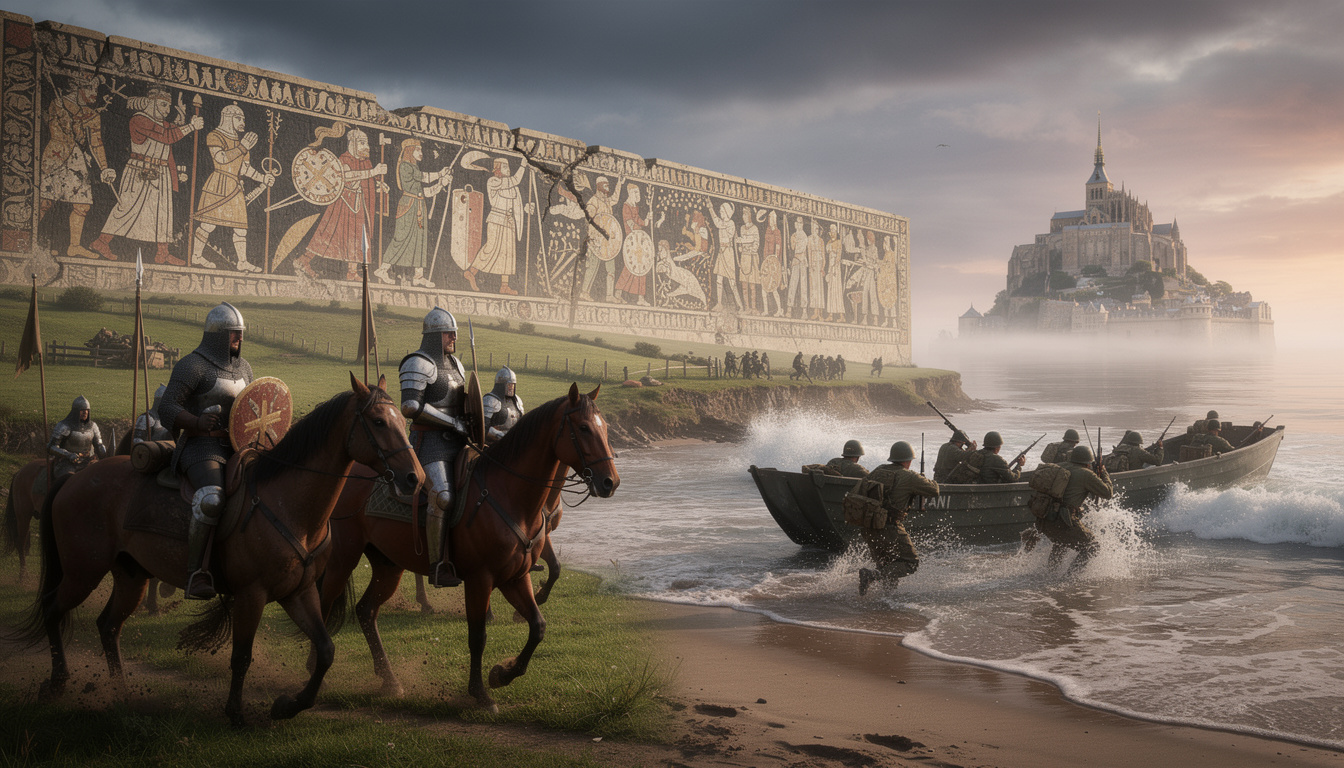
History of Normandy and its events that changed the world — Along its beaches, cliffs and stone towns, Normandy tells an epic that crossed paths with Vikings, dukes, conquerors and allied armies. A pivotal region facing the English Channel, it was a gateway, a base for expansion and the scene of battles whose repercussions shaped Europe. From the founding of the duchy by the Scandinavians to the Norman Conquest of England, up to the Allied landing of 1944, each era has left the modern visitor a rich heritage and geopolitical lessons that remain relevant.
This overview follows the thread of centuries by tracing the fictional journey of a Norman archivist, Lucien Martel, who, from the foreshore to the archives of Rouen, connects documents, stones and oral accounts to show how Normandy influenced the world. The following sections explore the strategic geography, the Viking genesis of the duchy, the Norman Conquest led by William the Conqueror, the medieval golden age of cathedrals and fortresses, then the decisive role of the region during the Second World War and D-Day.
Normandy’s geographic position: a strategic crossroads facing the English Channel
Normandy owes much of its destiny to its geographic location. Bordered by the English Channel, with natural ports such as Le Havre and Cherbourg, the region established itself as an interface between France and the British Isles. This maritime frontage made Normandy an essential passage for trade, emigration and military operations.
A coastline that commands maritime routes
The shape of the coast, deep estuaries and natural shelters enabled the growth of naval activities since Antiquity. Maritime routes linking northern Europe to the Atlantic often passed along the Norman arc, promoting the exchange of goods and ideas. In the Middle Ages, these conditions partly explain the emergence of powerful ports and influential merchant families.
Border, gateway for attack and field of conquest
Militarily, the proximity to the English Channel explains why Normandy was successively a frontier and a launching ramp. Viking invasions in the 9th–10th centuries and then Anglo-Norman expeditions took advantage of this geography. In the 20th century, the same frontage provided a strategic advantage for Operation Overlord, since the Norman beaches allowed the Allied landing that would change the course of the war.
A region connected to European centers of power
Normandy is also within short distance of major metropolises: about two hours from Paris, close to British sea routes and to the Seine River which opens onto the interior of the country. This connectivity fostered strong economic and political dynamics. Lucien Martel, in his research, notes that cross-Channel exchanges largely influenced local institutions and practices.
To deepen this geographic and political context, the reader can consult overview resources such as the historical portrait of the region or the comprehensive presentation of Normandy.
Final insight: Normandy is not just a coastline: across the centuries it has been a strategic interface between kingdoms, economies and cultures, which explains its disproportionate role in European history.
From Viking origins to the founding of the duchy: Rollon and the genesis of Normandy
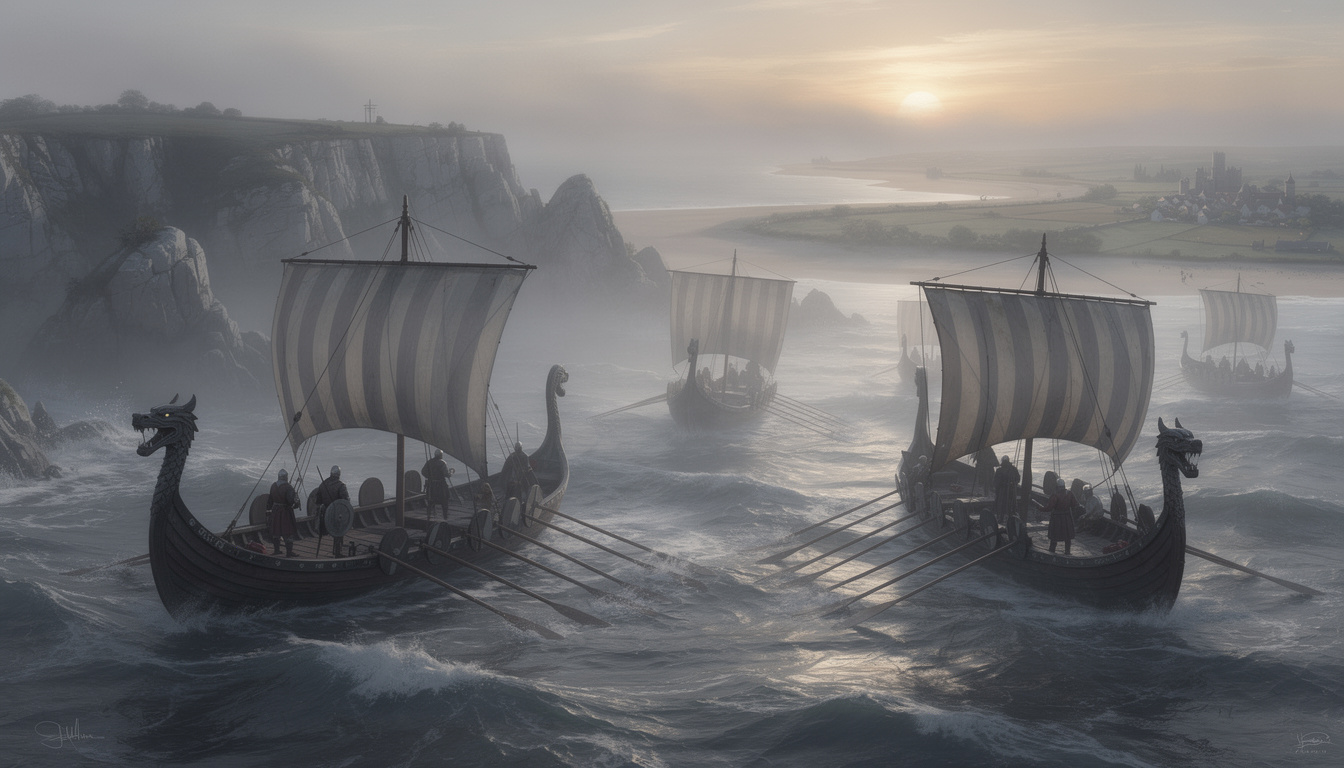
The first foundations of Normandy were written in contact with Scandinavian incursions which, from the 9th to the 10th century, disrupted the northwest of France. These waves of attacks and settlements gave rise to an original political reality: Viking leaders gradually settled, became sedentary and, in some cases, merged into the local fabric.
From raid to settlement: mechanisms of a transformation
The initial raids, often seasonal, evolved into lasting occupations. Scandinavian settlements relied on mastery of navigation and the search for arable land. Political negotiation, rather than only military conquest, played a key role: in 911, after years of clashes, a negotiation led to the treaty often associated with the figure of Rollon. This act marks the formalization of a Scandinavian power recognized by the Frankish kingdom and gives birth to the nascent duchy.
Rollon and the emergence of the Norman duchy
The figure of Rollon embodies this mutation: a Viking leader transformed into an established lord, he represents the capacity for integration and adaptation of the new masters of the coast. The establishment of marital alliances, conversion to Christianity and the adoption of Frankish administrative structures allowed the duchy to gain legitimacy. The Scandinavian implantation then took on an original appearance: a Norman aristocracy that retained Nordic traits while inserting itself into the Carolingian feudal sphere.
The emerging Norman culture: language, law, practices
The meeting of Scandinavian traditions and Gallo-Frankish heritage encouraged syncretisms visible in toponymy, maritime practices and legal structures. The emerging Norman borrowed both from Frankish customary law and Scandinavian usages. These evolutions entangled the region with a specific identity, both insular and continental.
On the museographic and awareness-raising level, recent projects illustrate this return to roots, such as the laying of the first stone of the Viking Interpretation Center at Ornavik Park on May 27, 2025, which invites better understanding of these origins. For an accessible synthesis, see the index of articles dedicated to the region’s great eras on Patrimoine Normand and the historical dossier offered by the dedicated Wikipedia page.
Final insight: Normandy was built through exchange and adaptation; the transformation of Vikings into Norman dukes shows the political and cultural integrative strength that characterizes the region.
William the Conqueror and the Norman Conquest: Battle of Hastings and the Invasion of England (1066)
The episode of 1066 is one of the major turning points in European history. As Duke of Normandy, William the Conqueror launched an expedition that culminated in the Battle of Hastings and the Invasion of England. The political and cultural impact of this enterprise went beyond borders: it transformed the English nobility, redrew the map of power and spread Norman practices at the heart of England.
Preparation, embarkation and tactics
The logistical organization of such an undertaking illustrates Norman maritime power. William assembled a fleet and contingents of knights, exploiting feudal relations and port resources. On 14 October 1066, the decisive encounter with Anglo-Saxon forces led to a victory that durably shifted the political balance in England.
Political and feudal consequences
William’s victory led to the redistribution of lands and the establishment of a reshaped feudal system. Baronies were granted to Norman loyalists, allowing administrative and legal institutions of Norman origin to penetrate England. This transformation had lasting repercussions on language, feudal practices and lordly architecture.
Culture, art and memories: the Bayeux Tapestry
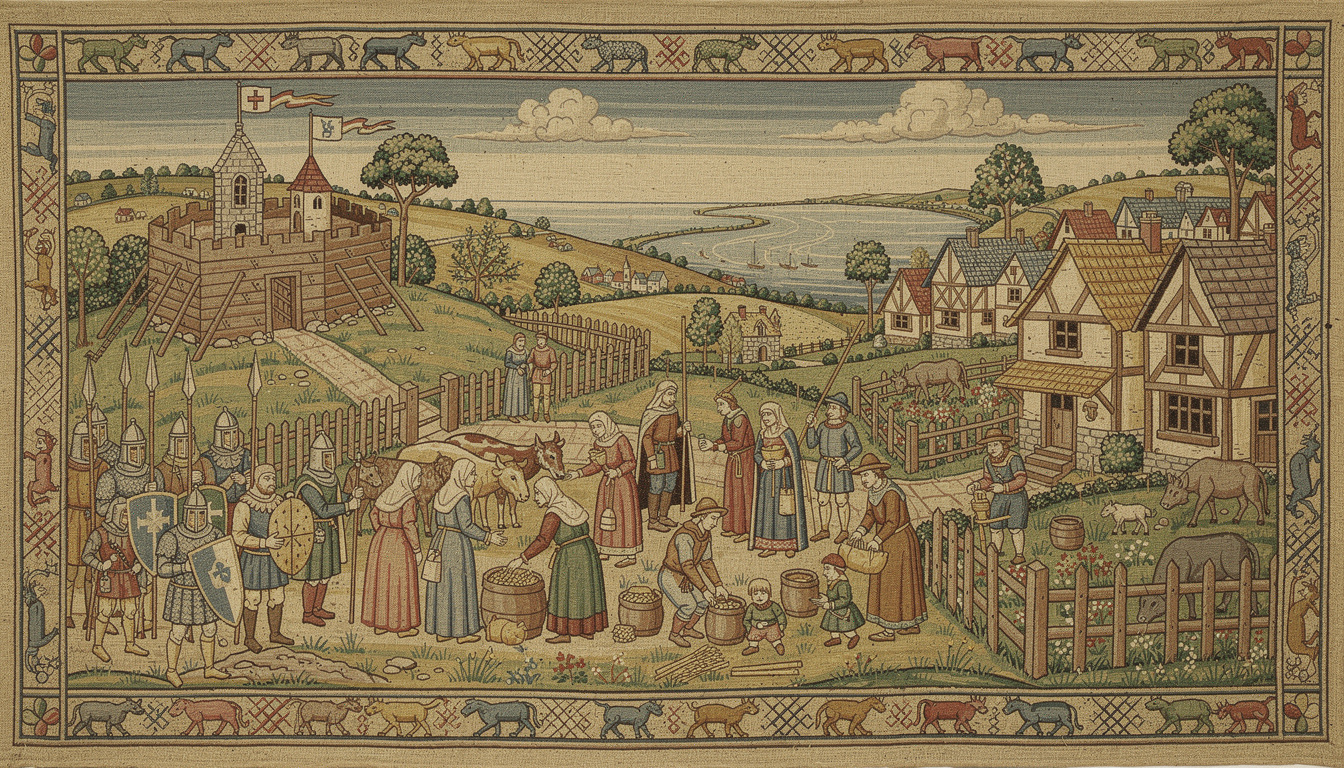
The Bayeux Tapestry remains an essential artistic testimony of the Norman Conquest. This 11th-century embroidered work illustrates the preparations and the battle, and serves as a study object for understanding perceptions and propaganda of the time. The museum itinerary of the tapestry, and its scheduled restoration, are part of an ongoing effort to highlight the Norman heritage. More information on movements and conservation is available via regional museum and cultural resources.
To deepen the chronology and context, Routard offers a practical synthesis, and specialized dossiers can be found on Normandie Découverte. Lucien Martel, traveling through cartularies and chronicles, highlights how the Norman Conquest generated a system of reciprocal influences between Normandy and England.
Final insight: the 1066 campaign was not merely a military victory; it established institutional and cultural transfers that permanently linked Normandy to the British destiny.
Medieval Normandy: Gothic cathedrals, fortresses and cultural influence
During the Middle Ages, Normandy consolidated its status as an influential region. Monumental constructions — cathedrals, abbeys, castles — reflect the wealth and ambition of local elites. These buildings, often preserved or restored, now constitute an essential part of the Norman heritage and the region’s identity narrative.
Cathedrals and the rise of Gothic
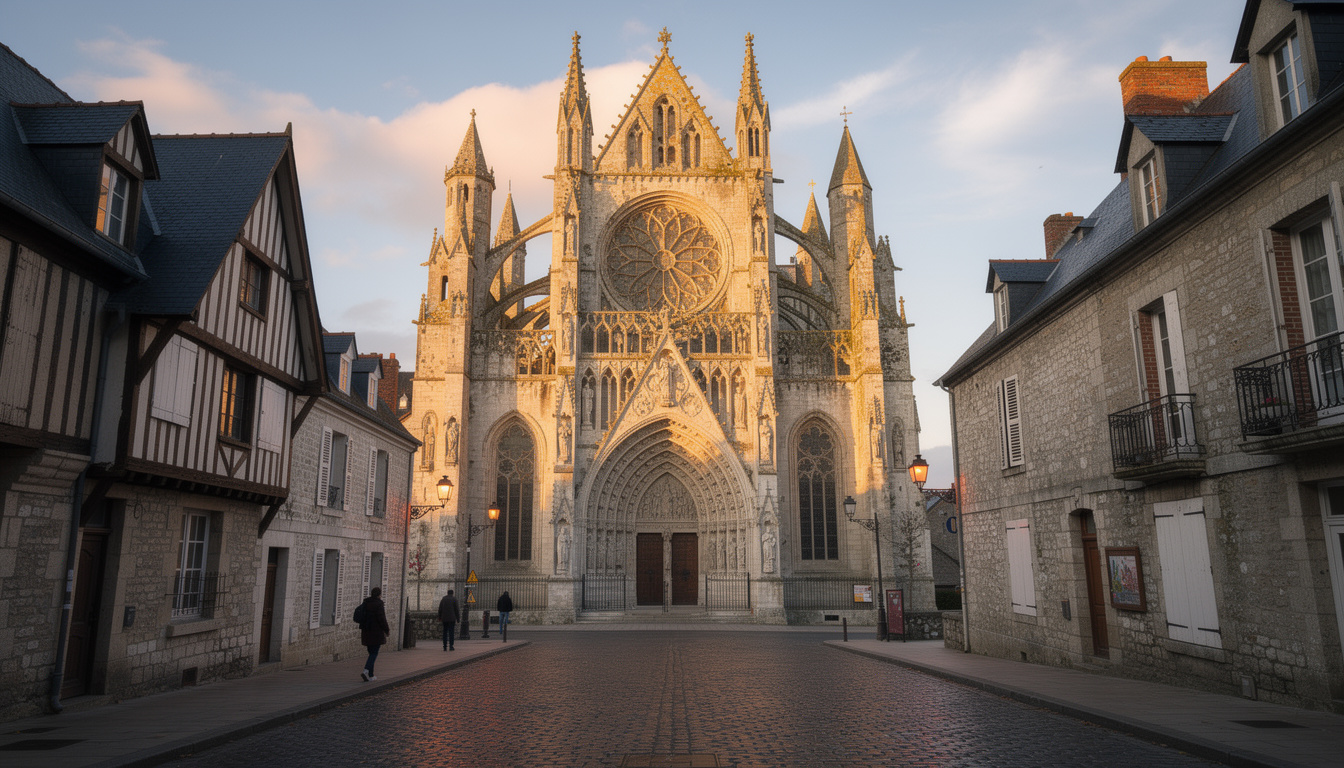
Rouen offers a striking example with its cathedral, whose silhouette inspired painters and poets. Gothic architecture, through verticality and light, expresses a new religious and civic aesthetic. The Abbey of the Holy Trinity in Caen and other Norman abbeys also testify to this flourishing, linked to the prestige ambitions of the dukes and major religious orders.
Fortresses, castles and territorial defense
Fortifications such as the Château de Chambois recall the need to control land routes. These strongholds, sometimes transformed into museums or heritage sites, allow the reconstruction of Norman lords’ military strategy. The Château of Gisors remains associated with stories and myths that enrich regional memory.
Cultural influence and the spread of practices
Cross-Channel exchanges encouraged a circulation of ideas and techniques: arts, culinary customs and legal systems traveled with the Norman elites. The monastic network and pilgrimages contributed to this cultural and economic influence.
List: main medieval sites to visit
- Rouen Cathedral (Notre-Dame de Rouen) (Seine-Maritime, 76) — a Gothic masterpiece accessible in about 1.5 hours from Paris.
- Abbaye-aux-Dames in Caen (Calvados, 14) — linked to William the Conqueror and events of the 11th century.
- Château de Chambois (Orne, 61) — preserved keep and viewpoint over the Dives valley.
- Bayeux Tapestry Museum (Calvados, 14) — conservatory of the 1066 epic.
- Gisors (Eure, 27) — fortress and Templar myths.
| Event | Date | Location | Impact |
|---|---|---|---|
| Treaty between Rollon and the King of the Franks | 911 | Saint-Clair-sur-Epte | Creation of the Duchy of Normandy, pacification of the coasts |
| Battle of Hastings | 1066 | Hastings (England) | Foundation of an Anglo-Norman monarchy; spread of institutions |
| Construction of Rouen Cathedral (Gothic phase) | 12th–13th centuries | Rouen (Seine-Maritime) | Artistic and religious influence |
For thematic reading, online dossiers such as Le Petit Futé or the portal Excellence France Tourisme offer itineraries and practical resources.
Final insight: medieval Normandy built its authority through visible monuments and networks of influence that persist in the region’s cultural landscape.
D-Day, the Allied Landing and the Second World War: 6 June 1944 and the reconstruction
6 June 1944 marks a decisive turning point in 20th-century history. Operation Overlord, prepared for months, saw the crossing of the English Channel by Allied forces and the opening of a second front in Western Europe. The Norman beaches — Omaha, Utah, Gold, Juno and Sword — became the scene of fierce fighting for the liberation of the continent.
Preparation, stakes and unfolding
The operation mobilized considerable logistics: ships, aircraft and troops from various Allied countries. The choice of the Norman beaches was not accidental: the topography, the maritime proximity to the United Kingdom and the possibility of opening beachheads explain this strategic option. The success of the operation depended on synchronization between maritime landings, parachute drops and naval and air support.
Military, political and human consequences
D-Day accelerated the liberation of France and the defeat of Germany. It had a major geopolitical impact: it enabled the Allies’ advance toward Germany and influenced the post-war configuration of Europe. Human losses were high: civilians and soldiers paid a heavy toll, and the memory of the sacrifices is today at the heart of places of remembrance.
Reconstruction and memory
Bombing and combat left cities severely damaged: Le Havre, Caen and other hard-hit cities had to be rebuilt. The work of architects such as Auguste Perret contributed to a reconstruction that combined modernity and respect for the past. Memory tourism, museums and commemorative beaches play an essential role in transmitting remembrance and historical interpretation.
Contemporary Normandy combines commemoration and economic renewal. Sites of memory, museums and educational routes offer varied itineraries. For practical resources and itineraries, consult the guide to exploring Normandy and thematic dossiers on gastronomy and heritage such as Norman culinary specialties that accompany visits to historical sites.
Final insight: the Allied landing not only liberated a region and a continent, it also imposed on Normandy a chapter of reconstruction and memory that still shapes its identity and global influence.
Resources, links and practical recommendations
For a complete and documented reading, historical syntheses and online archives remain indispensable. The reader will find dossiers, articles and itineraries from reliable sources such as the official Normandy portal and in-depth articles listed on Patrimoine Normand.
{“@context”:”https://schema.org”,”@type”:”FAQPage”,”mainEntity”:[{“@type”:”Question”,”name”:”Why was Normandy strategic for invasions and maritime exchanges?”,”acceptedAnswer”:{“@type”:”Answer”,”text”:”The coastline on the English Channel provides natural ports and estuaries that facilitate landing and navigation. This position favored commercial exchanges, Viking settlements and military operations, making Normandy a European crossroads.”}},{“@type”:”Question”,”name”:”Who was Rollon and what role did he play in the creation of the duchy?”,”acceptedAnswer”:{“@type”:”Answer”,”text”:”Rollon was a leader of Scandinavian origin who, after years of military actions and settlements, negotiated an agreement in 911 that granted him lands and legitimized the formation of the Duchy of Normandy, initiating a process of acculturation and institutionalization.”}},{“@type”:”Question”,”name”:”How did the Battle of Hastings transform England?”,”acceptedAnswer”:{“@type”:”Answer”,”text”:”William’s victory in 1066 led to the redistribution of land, the establishment of an Anglo-Norman aristocracy and major institutional and linguistic developments that shaped medieval English society.”}},{“@type”:”Question”,”name”:”What is the impact of the 1944 Landing on Normandy today?”,”acceptedAnswer”:{“@type”:”Answer”,”text”:”The Landing caused significant destruction and human losses but also paved the way for the liberation of Europe. Reconstruction and remembrance have influenced the region’s urban planning, economy and commemorative tourism.”}}]}Why was Normandy strategic for invasions and maritime exchanges?
The coastline on the English Channel provides natural ports and estuaries that facilitate landing and navigation. This position favored commercial exchanges, Viking settlements and military operations, making Normandy a European crossroads.
Who was Rollon and what role did he play in the creation of the duchy?
Rollon was a leader of Scandinavian origin who, after years of military actions and settlements, negotiated an agreement in 911 that granted him lands and legitimized the formation of the Duchy of Normandy, initiating a process of acculturation and institutionalization.
How did the Battle of Hastings transform England?
William’s victory in 1066 led to the redistribution of land, the establishment of an Anglo-Norman aristocracy and major institutional and linguistic developments that shaped medieval English society.
What is the impact of the 1944 Landing on Normandy today?
The Landing caused significant destruction and human losses but also paved the way for the liberation of Europe. Reconstruction and remembrance have influenced the region’s urban planning, economy and commemorative tourism.
Links for further reading: consult the Wikipedia page on the history of Normandy, the dossier of the historical portrait of the region, practical resources from Routard, as well as analyses and narratives on Normandie Découverte and thematic articles available via local portals.